The indie game scene has always been closely tied to accessible tools. While modern engines dominate headlines, there is a quiet but persistent community of developers who continue to create free games with GameMaker 8, a tool released more than a decade ago. At first glance, this might seem like nostalgia or resistance to progress. In reality, the reasons are far more practical, creative, and technical than many assume. GameMaker 8 remains relevant not because it competes with modern engines feature by feature, but because it fulfills a specific role in indie development that newer tools often overlook.
GameMaker 8 and Its Place in Indie Game History
GameMaker 8 occupies a unique position in the history of indie game development. Long before engines like Unity or Godot became industry standards, GameMaker provided a gateway for non-programmers to turn ideas into playable experiences. Many of today’s well-known indie developers took their first steps using this engine, releasing early free indie games built with GameMaker on forums and community sites.
What makes GameMaker 8 especially important is its timing. It arrived when digital distribution was still fragmented, and indie developers relied heavily on freeware releases to build an audience. As a result, the engine became strongly associated with experimental design, short-form games, and creative risks. That cultural legacy still matters today. Developers who continue using GameMaker 8 are often tapping into a tradition of fast iteration, personal expression, and community-driven feedback that newer engines, despite their power, sometimes complicate.
Why Free Game Developers Still Choose GameMaker 8
One of the strongest reasons developers keep using GameMaker 8 is efficiency. The engine allows creators to focus on gameplay logic rather than engine architecture. For developers making free PC games with GameMaker, this simplicity translates into faster development cycles and fewer technical barriers.
Another key factor is stability. GameMaker 8 is a finished product with no breaking updates. Developers know exactly how it behaves, which is especially valuable for solo creators or small teams releasing freeware projects without long-term maintenance plans. When a game is meant to be distributed for free, predictability often matters more than cutting-edge features.
There is also the issue of hardware accessibility. GameMaker 8 games typically have extremely low system requirements. This makes them ideal for players using older PCs, school computers, or low-spec laptops, expanding the potential audience for free indie releases. In an era where many engines assume powerful GPUs and large memory budgets, this advantage is more significant than it first appears.
Technical Strengths That Still Matter Today
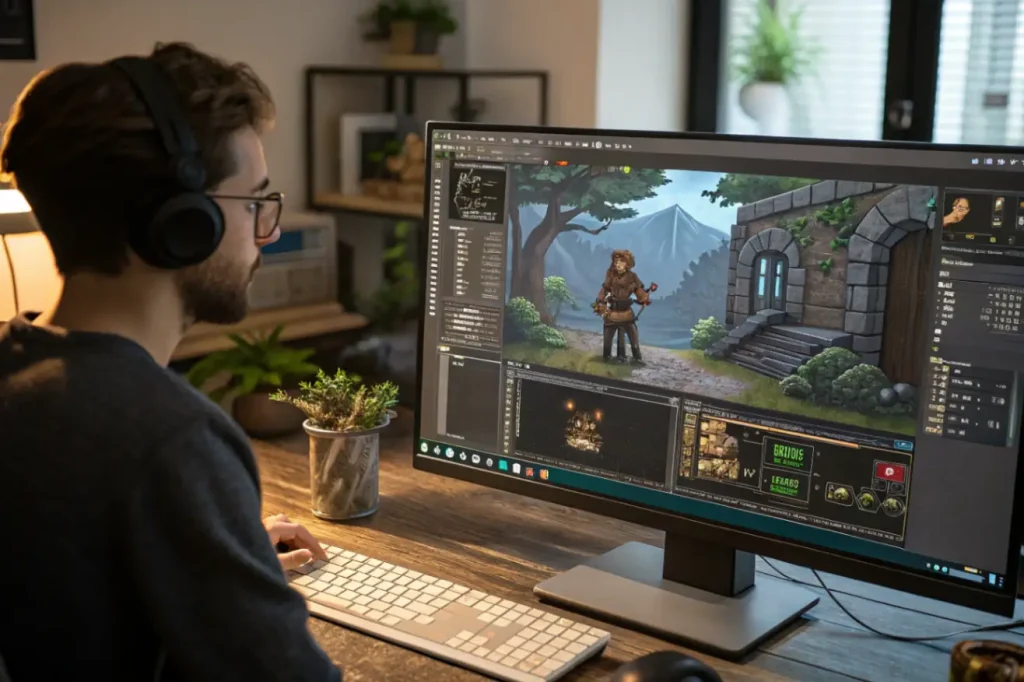
From a purely technical perspective, GameMaker 8 remains surprisingly capable for 2D game development. Its scripting language, GML, offers a balance between visual logic and code-based control that many developers still find intuitive. For prototyping mechanics, building small-scale projects, or experimenting with unconventional gameplay systems, the engine remains efficient.
Collision handling, sprite management, and room-based level design are deeply integrated into the workflow. This tight integration reduces setup time and allows developers to move quickly from idea to playable build. For creators focused on free indie games, where scope is often intentionally limited, these strengths align perfectly with their goals.
To better understand how GameMaker 8 compares to newer engines in the context of freeware development, it helps to look at some core characteristics side by side.
Before reviewing the comparison, it’s important to note that this table focuses specifically on the needs of developers releasing free games, not commercial-scale projects.
| Feature Area | GameMaker 8 | Modern Indie Engines |
|---|---|---|
| Learning Curve | Very low, beginner-friendly | Moderate to steep |
| System Requirements | Extremely low | Medium to high |
| Update Stability | Fully static | Frequent changes |
| Ideal Game Scope | Small to mid-scale 2D | Small to large, 2D/3D |
| Freeware Focus | Strong community tradition | Mixed priorities |
As this comparison shows, GameMaker 8 continues to meet a niche set of requirements that modern engines do not always prioritize.
Community, Legacy, and Free Game Distribution
The continued use of GameMaker 8 is also driven by its long-standing community. Over the years, thousands of free GameMaker games have been shared across forums, indie archives, and fan sites. These platforms still host tutorials, source code examples, and completed projects that new developers can study and modify.
This legacy ecosystem lowers the barrier to entry even further. A beginner can download the engine, browse old community resources, and quickly understand how complete games were built. Unlike modern engines, where documentation often assumes professional workflows, GameMaker 8’s learning materials are grounded in hobbyist experimentation and creative freedom.
Within this community-driven environment, developers often cite several recurring motivations for sticking with the engine:
- Rapid prototyping without engine overhead.
- Familiar workflows developed over many years.
- Strong alignment with small, experimental game concepts.
- Easier sharing of source code for educational purposes.
- A nostalgic but still active player base.
These factors reinforce each other. The more developers continue using the engine, the more valuable the existing ecosystem becomes, especially for free projects that rely on community interest rather than marketing budgets.
Creative Freedom Over Technical Ambition
Another overlooked reason developers stick with GameMaker 8 is creative focus. Modern engines offer enormous power, but that power often comes with complexity. Lighting systems, asset pipelines, shaders, and optimization layers can distract from core game design, especially in small teams.
GameMaker 8, by contrast, encourages limitations. These limitations often lead to stronger design decisions. Developers working within the engine’s constraints tend to prioritize mechanics, pacing, and player feedback rather than visual spectacle. This approach aligns well with the philosophy behind many free indie games, where innovation and originality matter more than production value.
In practice, this means GameMaker 8 remains an ideal tool for narrative experiments, arcade-style games, and genre hybrids that might struggle to find an audience in commercial marketplaces. Free distribution removes financial pressure, and the engine’s simplicity supports that creative freedom.
Why GameMaker 8 Still Has a Future in Free Indie Games
Despite its age, GameMaker 8 is unlikely to disappear from the indie landscape anytime soon. As long as developers continue to value accessibility, speed, and creative control, there will be room for tools that prioritize those qualities over technical advancement.
Free games, in particular, benefit from engines that do not demand long-term support, monetization frameworks, or constant updates. For many creators, GameMaker 8 represents a complete, reliable toolkit that allows them to focus entirely on making and sharing games.
The persistence of free games made with GameMaker 8 is not a rejection of modern technology. It is a reminder that innovation in indie development often comes from constraints, not abundance. In that sense, the engine remains as relevant today as it was when it first empowered a generation of indie creators.
Conclusion
GameMaker 8 continues to thrive in the world of free indie games because it solves a specific set of problems better than most modern engines. Its simplicity, stability, low system requirements, and deeply rooted community make it an ideal choice for developers who value creative expression over technical complexity. While the industry moves forward, GameMaker 8 stands as proof that older tools can still play a meaningful role when they align with the goals of their users.