A launch does not create an audience. It asks one that already exists to pay attention, and if nobody was listening beforehand, the loudest day of the project arrives in silence.
Building that audience starts long before the game is finished, while the project is still unfinished and the sharing is easy to do honestly.

Attention is built in small pieces
Reach grows from many small, repeated appearances. One announcement at the end cannot compensate for months of near silence. Sharing early also makes the release feel like a return rather than an introduction to strangers.
Post the work as it happens: a mechanic, a fixed bug, a sketch, a decision. Progress is more interesting to watch than a polished reveal.
Consistency beats volume. A short update every week outperforms a burst of activity followed by nothing for a season.
Keep a simple record of what was shared and where. Without it the same screenshot is posted twice while the more useful topics are forgotten. Publish where the players of this kind of game already gather. A perfect post on the wrong platform reaches nobody who would play it.
A store page earns its place early
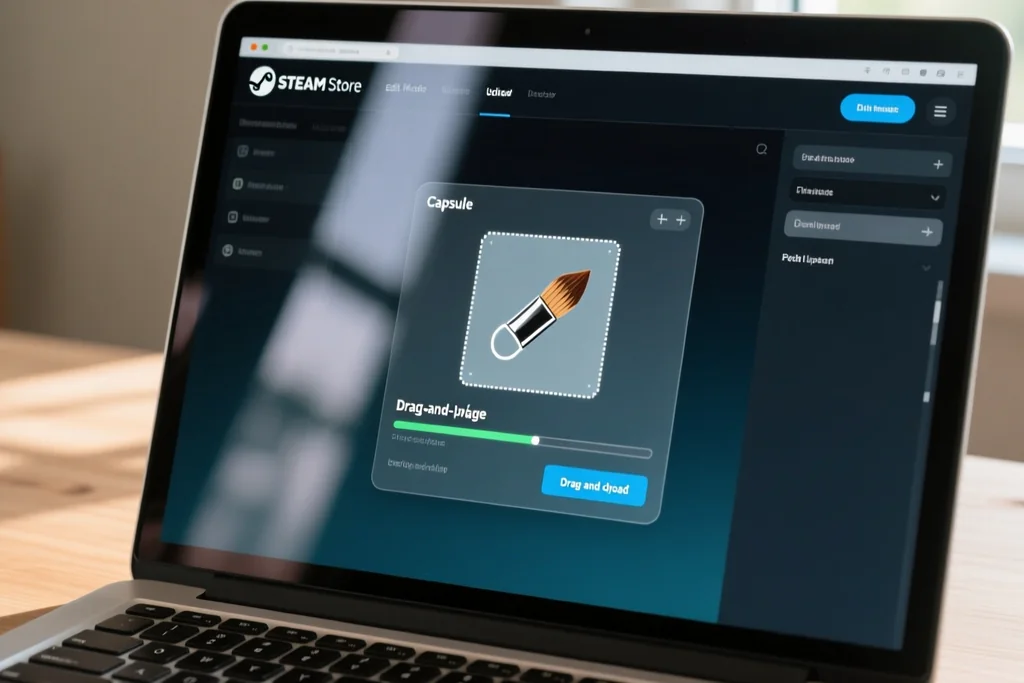
A store page is not the final step of a release. It is a collecting point for everyone who becomes interested during development.
Publish it as soon as the game has a name and a clear idea. Every mention afterwards then has somewhere useful to send people.
Refine the page as the game changes. Capsules, screenshots and the opening lines are the part most visitors actually read.
Keep the contact and press details on the same page. Editors and event organisers look for that information long before launch.
Devlogs turn process into interest
A devlog answers the question a curious player actually has: how is this being made, and is it going well enough to wait for?
Write about decisions rather than announcements. Why a mechanic was cut teaches more than a list of what has recently been added.
Keep the format light. A post that takes a whole evening will stop after a month, and stopping is worse than a rough one.
Keep a list of topics for quiet weeks. A ready list removes the pause that ends most devlogs after the first few posts.
Communities beat broadcasts
A broadcast reaches strangers once. A community keeps a smaller group returning and lets those people talk to each other about the game.
Choose one or two places and stay there. Spreading thin across many platforms produces a shallow presence everywhere and depth nowhere.
Answer questions and share early builds with the people who follow closely. That group becomes the first wave of players at release.
Answer more than you post. Helpful replies build recognition faster than announcements, which strangers read once and instantly forget.
Build a list the project owns
Followers on a platform are borrowed. A mailing list, a site or a feed belongs to the project and survives a change in the algorithm.
Give people a clear reason to move from a social page to the list: an early build, a note when something ships, a small extra.
Keep it small and honest. A short list of genuinely interested people is worth more than a large one assembled by accident.
Ask once and never again. Repeated requests for signups turn quiet interest into mild irritation within a few posts.
Time the push, not the noise
There is a moment when more attention genuinely helps: when the game is close enough that a visitor can see it will actually arrive.
| Channel | What it produces | Main risk |
|---|---|---|
| Store page | A place to collect interest | Published too late |
| Devlog | Curiosity and context | Abandoned after a month |
| Community | A returning group | Spread too thin |
| Mailing list | Direct reach | No reason to join |
| Launch push | A short peak | Nothing underneath it |
Save the largest effort for that window. Spending it months early produces interest that has nowhere to wait until the game is ready.
After launch the same small efforts keep working. The release day itself is a peak in the curve, not the whole shape of it.
Coordinate the peak with something real. A demo, a festival or a release date gives the arriving attention a reason to stay.

Audience before marketing: finding the players who care
Related guide on this topic.
Measure interest, not applause
Followers and reactions are easy to count and hard to read. Wishlist entries, signups and demo downloads show real intent instead.
Watch which posts produce signups rather than which produce laughs. That tells the developer which part of the game attracts players.
Ignore a quiet week. Audience building is a slow line of small steps, and reading it day by day produces anxiety rather than insight.
Compare the same window across several weeks. A long view shows the small, steady growth that actually predicts a launch.
- Publish the store page as soon as the game has a name.
- Share progress weekly instead of saving it for a reveal.
- Write about decisions, not only announcements.
- Choose one or two communities and stay active in them.
- Compare channels by signups, not by reactions.
Audience building looks like a distraction while the game is unfinished. It is the only work that makes the finished release audible at all.
The methods are modest: show the work, keep a place to collect interest, and continue long enough for it to matter.