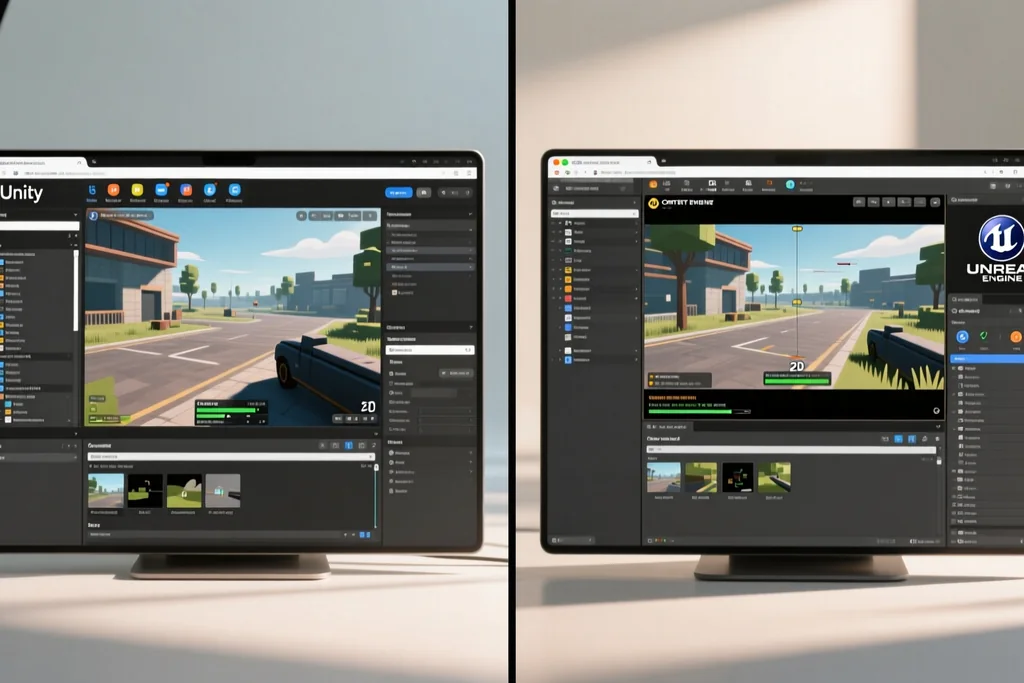
Tooling changes quietly. Headlines go to new rendering features, while the everyday difference is a project that starts from a template instead of an empty file.
Looking at the last decade of editor work, three shifts changed what one person can attempt: prefabs, visual scripting, and pipelines that ship a build without manual packing.

From blank project to starting templates
An empty project used to be the honest starting point. A new file now often begins with a menu, a save routine and a movement prototype that already runs.
Templates remove the least interesting work and leave the design decisions. That sounds small until the alternative is rebuilding the same scaffolding for every prototype.
The risk is a project made of borrowed parts. A template is a starting point, and its structure has to be understood before it is extended.
Choose a template that matches the shape of the game rather than the taste of the developer. A style that fights the template costs more time than it saves.
Prefabs replaced copy-and-paste
Duplicating an object and editing every copy was once ordinary practice. A prefab keeps one definition, and each placement in the level inherits it.
Change the source and every instance updates. For a solo developer that is the difference between one edit and dozens, every time a value changes.
Prefabs also make experiments cheap. A variation can be built from the base object without touching the version that already works.
Name prefabs carefully. A level built from objects called variant two and variant three becomes unreadable within a month.
Visual scripting grew into a real method
Drag-and-drop logic matured from a beginner's doorway into a serious authoring technique. Prototypes move faster when the rules are visible as connected nodes.
Projects now mix the two forms. Node graphs handle level logic and state machines, while performance-heavy systems stay in written code.
The practical rule is simple: choose the form the next person can read. Visually obvious logic belongs in a graph, dense calculation belongs in code.
Keep the boundary sharp. Mixing the two forms inside one system makes it hard to tell where a bug originated.
Pipelines left the developer's desk
Building was once a sequence of manual steps and a checklist. Automation services now take a commit, produce a build and run the tests without being asked.
Support tooling reached small teams at the same time. Crash reporting, analytics and store packaging used to be features only studios could afford to assemble.
The gain is not speed alone. An automated pipeline is repeatable, and repeatability is what makes a release week predictable instead of tense.
Set the build up early, while the project is still small. A pipeline added at the end arrives exactly when time is shortest.
Collaboration moved into the editor
Version control for binary assets used to be a separate problem. Editors now handle locking, merging and conflict warnings inside the tool itself.
Cloud projects lowered the setup cost further. A second person can join a project without a lecture about repositories and file locks.
None of it removes the need to commit often. Branching still works best when changes stay small and assets are treated as carefully as code.
Documentation arrived inside the tool
Reference material used to live in a browser tab. Modern editors show the signature, the description and an example while a function is being typed.
Integrated manuals shorten the distance between a question and an answer, which matters most during the first weeks with an unfamiliar tool.
Community content improved alongside it. Video, example projects and forums now carry as much practical weight as the official reference pages.
Keep project notes beside the code. In-editor help explains the tool, but only a note explains why this project does things its own way.
What changed in game tooling: editors, prefabs and pipelines
Related guide on this topic.
What has not changed
No tool has removed the need to understand the game being built. Better editing does not decide the loop, the pacing or the hook.
| Change | What it replaced | Effect on daily work |
|---|---|---|
| Starting templates | An empty project | Prototypes begin with working scaffolding |
| Prefabs | Duplicated objects | One edit reaches every placement |
| Visual scripting | Text-only logic | Rules become readable at a glance |
| Build pipelines | Manual release checklists | Repeatable builds on every commit |
| In-editor docs | Separate reference tabs | Answers appear where the work happens |
Structure still wins. Clear naming, small scenes and honest budgets survive every update, while clever shortcuts age badly and cost time later.
Tooling changes what is cheap to try. Judgement still decides what is worth keeping, and that part stayed exactly where it was.
- Start from a template, then read its structure before extending it.
- Keep one definition for anything placed in the level many times.
- Choose graphs for visible rules and code for dense calculation.
- Automate the build before the first release rather than during it.
- Commit often and treat assets with the same care as code.
The direction is consistent: less manual assembly, more time on decisions. Tools have absorbed the tedious parts of shipping and left the interesting ones.
That shift rewards judgement rather than labour. A developer who can choose what matters benefits most when the making itself gets easier.