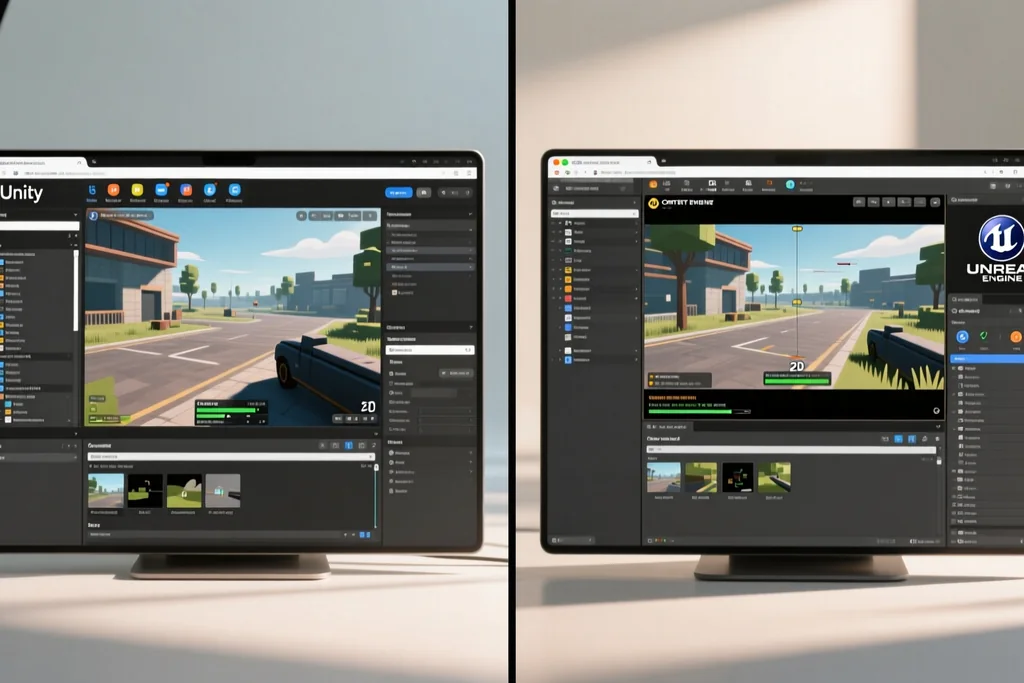
Ask a room full of indie developers which engine to use and you will start an argument that outlasts the meeting. The honest answer in 2026 is boring: the best engine is the one that matches your game's shape, your team's skills, and your shipping targets — not the one with the loudest community. Choosing well at the start saves a painful mid-project migration later.
The market has consolidated into four realistic options for indies, each with a distinct personality. The differences that matter are no longer about raw capability — all four can ship a commercial game — but about workflow, cost model, and platform reach.
The big four, by personality
Unity remains the generalist: strong 2D and 3D, the deepest asset store, and C# that transfers to other jobs. Its pricing controversies of recent years pushed many indies to evaluate alternatives, but the runtime-fee model now applies only above high revenue thresholds that most indie projects never reach.
Unreal is the ceiling-raiser. If your game lives or dies on visual fidelity — dynamic lighting, large 3D worlds, cinematic presentation — nothing else comes close at the price of free-until-a-million. The trade-off is weight: longer iteration times, a steeper C++ or Blueprints learning curve, and hardware demands that exclude low-end machines.
Godot is the indie darling for a reason. Fully free and open source under MIT, lightweight, excellent for 2D, and improving in 3D every release. GDScript reads like Python and onboards beginners in days. The ecosystem is younger, so you will occasionally build a tool yourself that Unity would sell you for twenty dollars.
GameMaker keeps its niche as the fastest path from idea to 2D game. Its drag-and-drop logic plus GML Code has shipped hits from Hotline Miami to Balatro's peers, and the free tier now covers non-commercial development entirely.
Match the engine to the game, not the hype
| Engine | Best for | Cost model | Main trade-off |
|---|---|---|---|
| Unity | 2D/3D generalist, mobile | Free below revenue threshold | Heavier toolchain, pricing history |
| Unreal | High-fidelity 3D, PC/console | 5% royalty above $1M | Steep learning curve, heavy builds |
| Godot | 2D-first indies, hobby to pro | Free, MIT license | Younger 3D tooling, smaller store |
| GameMaker | Fast 2D, pixel art, jam games | Free tier + subscriptions | Weaker outside 2D niche |
How to Choose a Game Engine in 2026: Unity, Unreal, Godot or GameMaker
Related guide on this topic.
A decision process that takes one weekend
- Define the game's shape first. 2D pixel-art roguelike and open-world 3D sim are different questions wearing the same "which engine" costume.
- Build the same tiny prototype twice — one weekend in each of your two finalists. The friction you feel in eight hours predicts the friction of eight months.
- Check your target platforms before falling in love. Console ports, web exports and mobile builds differ wildly in cost and effort per engine.
- Weight your own experience heavily. A mediocre choice you know deeply beats a perfect choice you will spend a year learning.
Whatever you pick, commit. Engine-hopping mid-project has killed more indie games than any bad first choice ever has.