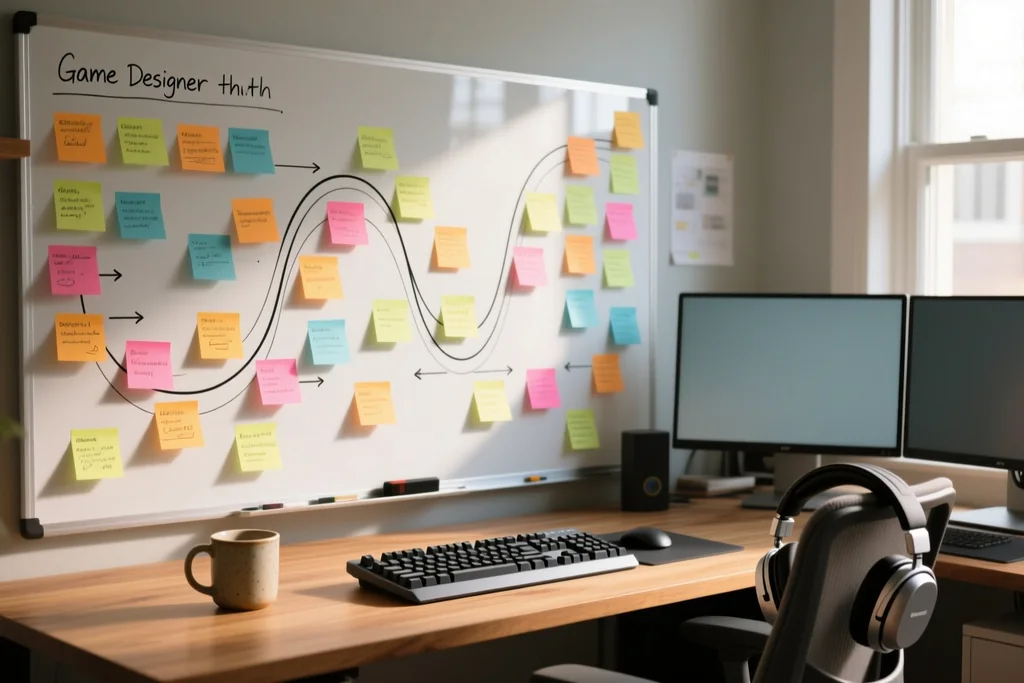
A level is not a container for enemies. It is a sequence of decisions, and the order in which they arrive teaches the rules without a single line of text.
Flow describes how the player moves through that sequence. Pacing describes how the pressure rises and falls along the way, and the two are designed together.

Teach in play, not in text
A mechanic introduced in a safe space is learned by doing. A prompt explains it; a room that requires it makes the player own it.
Introduce one idea at a time and let it stand alone before combining it with an earlier one. Combined teaching hides which rule actually failed.
Remove text wherever the layout already says it. A visible gap, a bright object or a locked path communicates far faster than a message box.
Place the first use of a mechanic where failure costs little. A lesson learned without a setback is remembered without resentment.
Space and sightlines do the guiding
Players read space before they read instructions. A corridor, a wide room and a change in height each set an expectation about what comes next.
Composition controls attention. Light, contrast and movement pull the eye, and the exit of a room should be the most obvious thing inside it.
Funnel the player with geometry rather than invisible walls. Being stopped by nothing visible breaks the trust the level was quietly building.
Use colour sparingly. When one element is bright and the rest are calm, the eye finds the intended path without any marker at all.
Difficulty is a curve, not a wall
Challenge should rise with the player's skill, which means the same encounter becomes easier once the available tools are understood.
Alternate pressure with recovery. A hard room placed immediately after another reads as unfair even when both are perfectly solvable.
Place the hardest test where the player has the most information. Difficulty at the very start of a level is confusion wearing a challenge costume.
Give the player an early easy success in every new area. Confidence makes the following, harder room feel like an invitation.
Rhythm of tension and release
Pacing is musical. Intensity rises, holds, then releases, and the release is what makes the next rise feel like something worth noticing.
Silence, empty corridors and low-risk exploration are not wasted space. They are the pauses that give the loud parts their shape.
Watch the length of a session. A level that never pauses becomes tiring, and tired players blame the game for the fatigue.
Vary the kind of pressure rather than only the amount. A puzzle after a fight rests different muscles than a quiet stretch of walking.
Signposting and rewards
A landmark serves two purposes at once: it tells the player where they are and gives them something to aim for from a distance.
Reward direction, not only progress. Confirmation that the player chose the right path keeps exploration from turning into guesswork.
Place the reward where it can be seen before it is reached. Anticipation does most of the motivational work on its own.
Repeat important landmarks in a different form. A shape seen from a distance and a light seen up close reinforce the same route.
Test pacing with someone new
A developer knows the level too well to feel its pacing. Watching a new player reveals where they slow, hesitate or miss the intended path entirely.
| Level element | Purpose | Common mistake |
|---|---|---|
| Safe introduction | Teach one rule | Combining two new ideas |
| Sightline | Guide without text | Hiding the exit behind clutter |
| Difficulty step | Match rising skill | Stacking two hard rooms |
| Quiet passage | Release pressure | Filling every corridor |
| Landmark | Orient and motivate | Making it invisible up close |
Say nothing while they play. Every hint given is a piece of information the level failed to communicate on its own, and it hides a real problem.
Note where they stop rather than where they fail. Hesitation usually marks a layout problem, while failure marks a difficulty one.
Record the session rather than watching everything live. The moments worth studying pass too quickly to catch from the chair.
Level flow and pacing: teaching without a tutorial
Related guide on this topic.
Edit the level like a text
Cut rooms that repeat a lesson already taught. A level that makes its point and moves on feels generous rather than long.
Reorder before extending. Moving an encounter earlier often fixes pacing better than adding a new one somewhere else.
Read the level as a sequence of verbs and remove anything that is not one of them. What remains is the part players will remember.
Keep the removed rooms somewhere. A cut section is often the right answer for a different area of the same level.
- Introduce one mechanic at a time in a safe space.
- Guide with geometry, light and sightlines instead of prompts.
- Separate hard encounters with quieter passages.
- Watch a new player without saying anything.
- Cut any room that repeats a lesson already taught.
Flow and pacing are invisible when they work. The player simply moves forward, understands what to do next and never notices the design holding their hand.
Getting there means testing the level as a first-time player would. The distance between a familiar layout and fresh eyes is where the real fixes live.